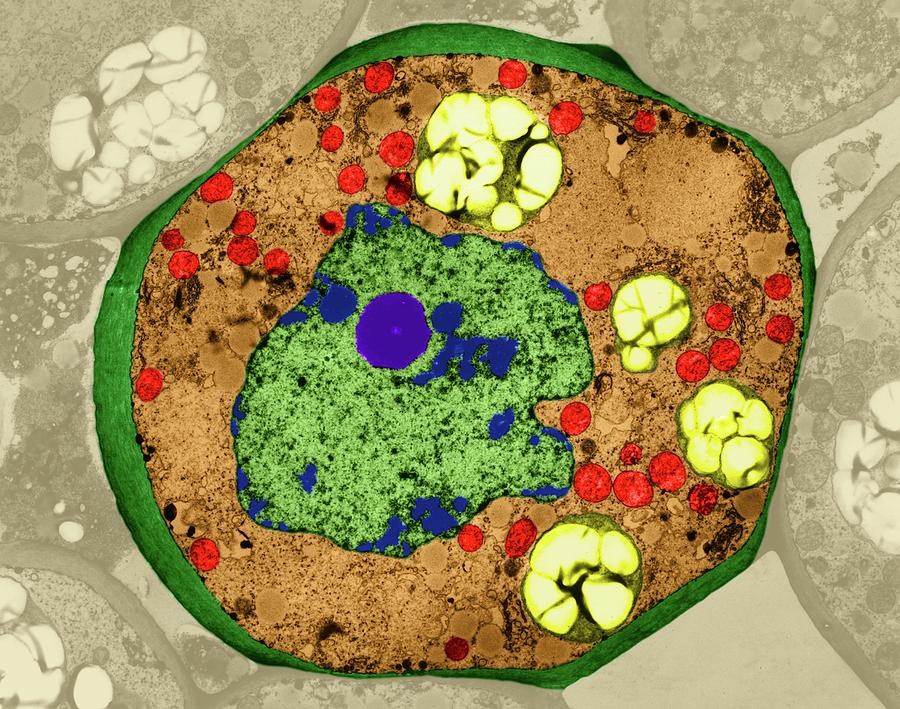
Parenchyma Cells In Plants. These cells are important constituents of various tissues in plants such as pith, cortex of roots and stems, as well as the mesophyll in the leaves. The cells are found in many places throughout plant bodies and, given that they are alive, are actively involved in photosynthesis, secretion, food storage, and other activities of plant life.
Parenchyma Cell From A Plant Photograph by Dennis Kunkel from fineartamerica.com
Characteristics of parenchyma in plants. Parenchyma cells are the foundation of a plant as reproductive cells (spores, gametes) are parenchymatous in nature single parenchyma cell of a zygote has an ability to develop into an entire plant. Parenchyma is one of the three main types of ground, or fundamental, tissue in plants, together… read more;
Plant Zygotes Are Also Made Of Single Parenchyma.
They can store food materials as starch grains, protein grains or oil droplets. Parenchyma cells are the most abundant of cell types and are found in almost all major parts of higher plants. Parenchyma in plants cells is either polyhedral or isodiametric in shape.
These Cells Are Called “Totipotent” Cells
Parenchyma in the primary plant body often occurs as a continuous mass, such as in the cortex or pith of stems and roots, the mesophyll of leaves and the flesh of fruits. Parenchyma is a functional cell in the plants and animal body. The parenchyma also acts as a storage tissue for food, air and water.
The Reproductive Cells Of Plants Like Gametes, Spores, Etc.
The micrograph shows a root cross section xylem ce
lls whose cell walls. Parenchyma is composed of large thin walled cells usually with a single large vacuole. Ground tissue is anything that is not vascular tissue or part of the dermis ( skin) of the plant.
The Cells Provide Mechanical Support To The Plant Body.
Parenchyma possesses an isodiametric symmetry. These cells are present in bulk at the soft part of leaves, fruit pulp, and other plant organs. Hard, structural features such as bark, outer coverings, and major veins in these structures are “structural” rather than “parenchymal” tissue.
In Contrast To Collenchyma And Sclerenchyma Cells, Parenchyma Cells Primarily Consists Of All Of The Simple, Thin Walled, Undifferentiated Cells Which Form A.
Thus, a parenchymatous zygote can grow into an entire plant through cell division. Parenchyma is the foundation of most plant cells. The plant cell is a eukaryotic cell made up of a definite nucleus and various membrane and non.