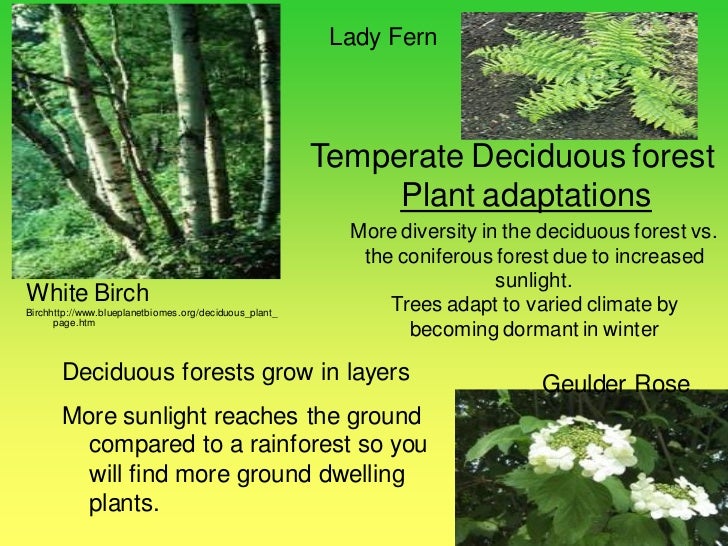
Temperate Deciduous Forest Plant Adaptations. Winter, spring, summer, and fall. Grows in the wild, especially in deciduous forests and the taiga of north america and eurasia.
Biome presentation from www.slideshare.net
Some birds find more food easily by migrating to. Temperate deciduous forests are most notable because they go through four seasons: Animals in the temperate deciduous forest have adapted in different ways to survive.
Deciduous Forests Are Those Where Trees Drop Their Leaves Each Year In The Autumn Because When Temperatures Drop, The Water Within The Leaves' Cells Freezes, Breaking The Cell Walls.
This adaptation allows plants to survive cold winters. Each acorn may only contain one seed but the odd 1 will have two or three but very rarely do you find one of those. They must be able to cope with cold winters when food is in short supply.
The Temperate Deciduous Forest Has All Four Seasons, Winter, Summer, Spring, And Fall.
Animals in temperate deciduous forests have to adapt to changing seasons. When the weather gets cooler, the broad leaves cause too much water loss and can be weighed down by too much snow, so the tree drops its leaves. They also need to adapt to the four distinct seasons (winter, spring, summer and fall) of this biome.
The Fronds Are Cut Twice And Grow From A Central Base.
Most of these trees shed their leaves to limit damage of branches and have thick bark to restrict the loss of moisture. The animals have to adapt a little bit in each season to help them survive. Adaptations to a temperate deciduous forest biome.
They Must Be Able To Cope With Cold Winters And Hot Summers.
Epiphytes, loads of different types in temperate rainforest (e.x. The temperatures change from hot in the summer to below freezing in the winter. Sharp canine teeth for capturing and eating pray.
This Type Of Leaf Structure Easily Captures The Sunlight Needed For Food Production (Photosynthesis).
When the weather gets cooler, the broad leaves cause too much water loss and can be weighed down by too much snow, so the. Migrat
ion and hibernations are two adaptations used by animals in this biome. Plant adaptations in deciduous forests forests are communities where trees form a closed canopy, so only low levels of sunlight can enter when the trees are leafed out.